TEL:
+86-0312-3189593
 English


Telephone:0312-3189593

Email:sales@oil-tester.com

Product Selling Point Introduction
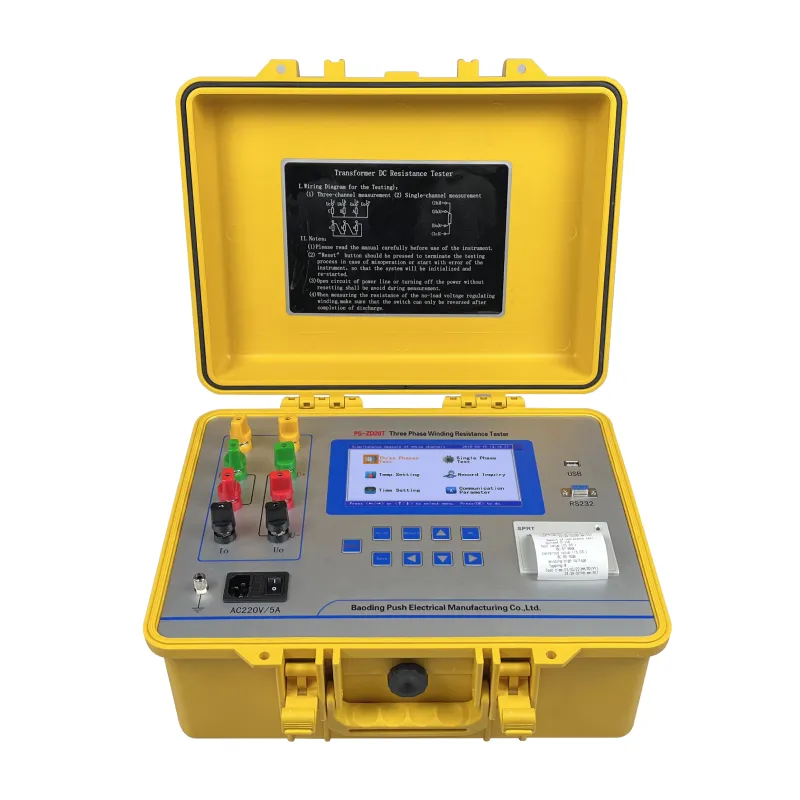
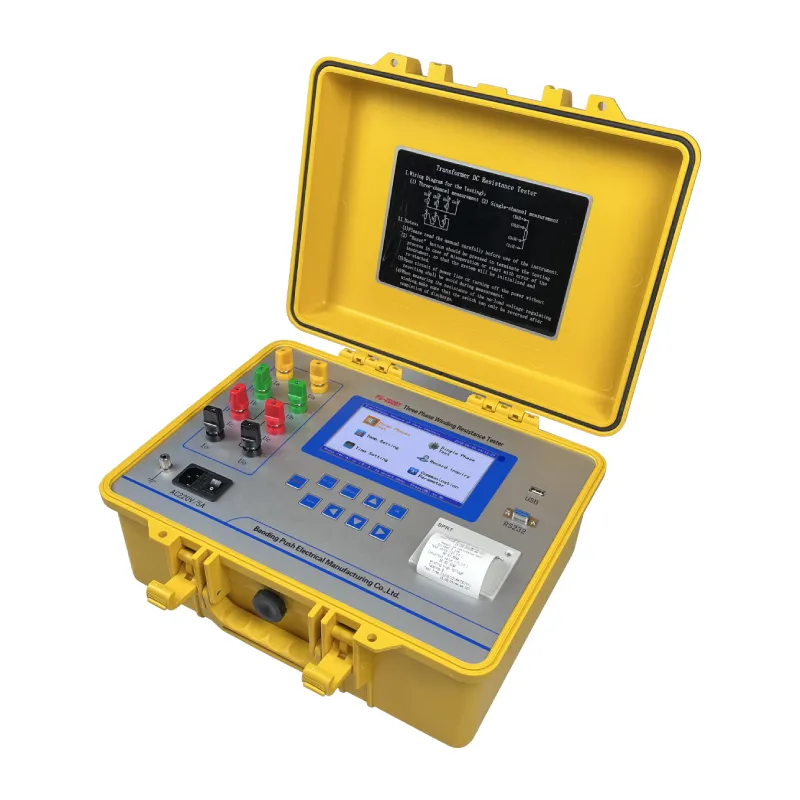
- 1. Displayer: colorful lattice LCD, displaying menu, test data and records.
2. Buttons: used for operation for corresponding functions indicated on the LCD or return the whole machine back to the initial state of energization.
3. Measuring current output terminal and voltage input terminal: under three-channel measurement mode, Ia, Ib,Ic, Io are current output, input channels; Ua, Ub, UC, Uo are voltage input channels. Under single-channel measurement mode, I+ and I- are current output, input channels; U+ and U- are voltage input channels.
4. Power switch, socket: including power switch of the whole machine, 220V AC power plug (with built-in 5A protective tube).
5. Earthing: earthing rod, for earthing of casing of the whole machine, belonging to protected field.
6. USB interface: interface between the instrument and U disk.
7. RS232 communication interface: communication interface between instrument and host computer.
8. Printer: printing information such as resistance value results and test current.
Product Parameter
Output current | select current automatically (maximum 20 A) |
Range ability | 0-100 Ω |
Accuracy | ±(0.2%+2words) |
Minimum resolution | 0.1 μΩ |
Working temperature | -20-40℃ |
Ambient humidity | ≤80%RH, no condensation |
Altitude | ≤1000meters |
Working power supply | AC220 V±10%, 60 Hz±1 Hz |
Volume | L 400 mm*W 340 mm*H 195 mm |
Net weight | 8kg |
Video
Write your message here and send it to us
Related News
-
 Precision Guide to the Electrode Used in Potentiometric TitrationPrecision Measurement: The Role of the Electrode Used in Potentiometric Titration In the realm of analytical chemistry and industrial quality control, achieving absolute precision is non-negotiable. The electrode used in potentiometric titration serves as the heart of this process, converting chemical activity into a measurable electrical potential. Whether you are analyzing petroleum products, environmental water samples, or pharmaceutical compounds, the selection of the right sensor determines the accuracy of your endpoint detection. By eliminating the subjectivity of visual color indicators, potentiometric methods provide a scientific, repeatable approach to quantitative analysis. In this guide, we will explore the technical intricaciesDetail
-
 High Precision Analysis Using the Potentiometer TitratorPrecision Analysis with the Potentiometer Titrator: An Industry Overview In the realm of high-precision chemical analysis, the potentiometer titrator serves as a critical instrument for determining the concentration of identified analytes in a solution. By measuring the potential difference between two electrodes, these devices provide unmatched accuracy in volumetric analysis, particularly in the oil and petroleum industries. Whether you are monitoring fuel quality or analyzing industrial lubricants, the ability to detect the exact equivalence point is paramount. This guide explores the technical superiority, applications, and operational benefits of integrating advanced titration systems into your laboratory workflow to ensure rigorous quality controlDetail
-
 Optimize Petroleum Analysis with Pour Point Test EquipmentOptimizing Petroleum Analysis with Pour Point Test Equipment In the petrochemical and lubricant industries, understanding the low-temperature flow properties of oil is critical for operational safety and efficiency. High-quality pour point test equipment provides the precise measurements needed to determine the lowest temperature at which a liquid remains pourable. Whether dealing with lubricating oils, fuels, or hydraulic fluids, ensuring that these substances do not solidify in cold climates is essential to prevent engine failure and system blockages. This guide explores the technical nuances, industrial applications, and the importance of choosing professional-grade instrumentation for petroleum analysis.Detail